Set within a Midwestern family home along the shores of Lake Michigan, Scrap Book explores the prison sentence Martino’s father served before he was born and its aftermath in which he was raised.
“Weaving poems with invented forms, familial documents, and fragmented memory, Martino constructs an autoethnographic study of carceral trauma and its reverberations across generations.”
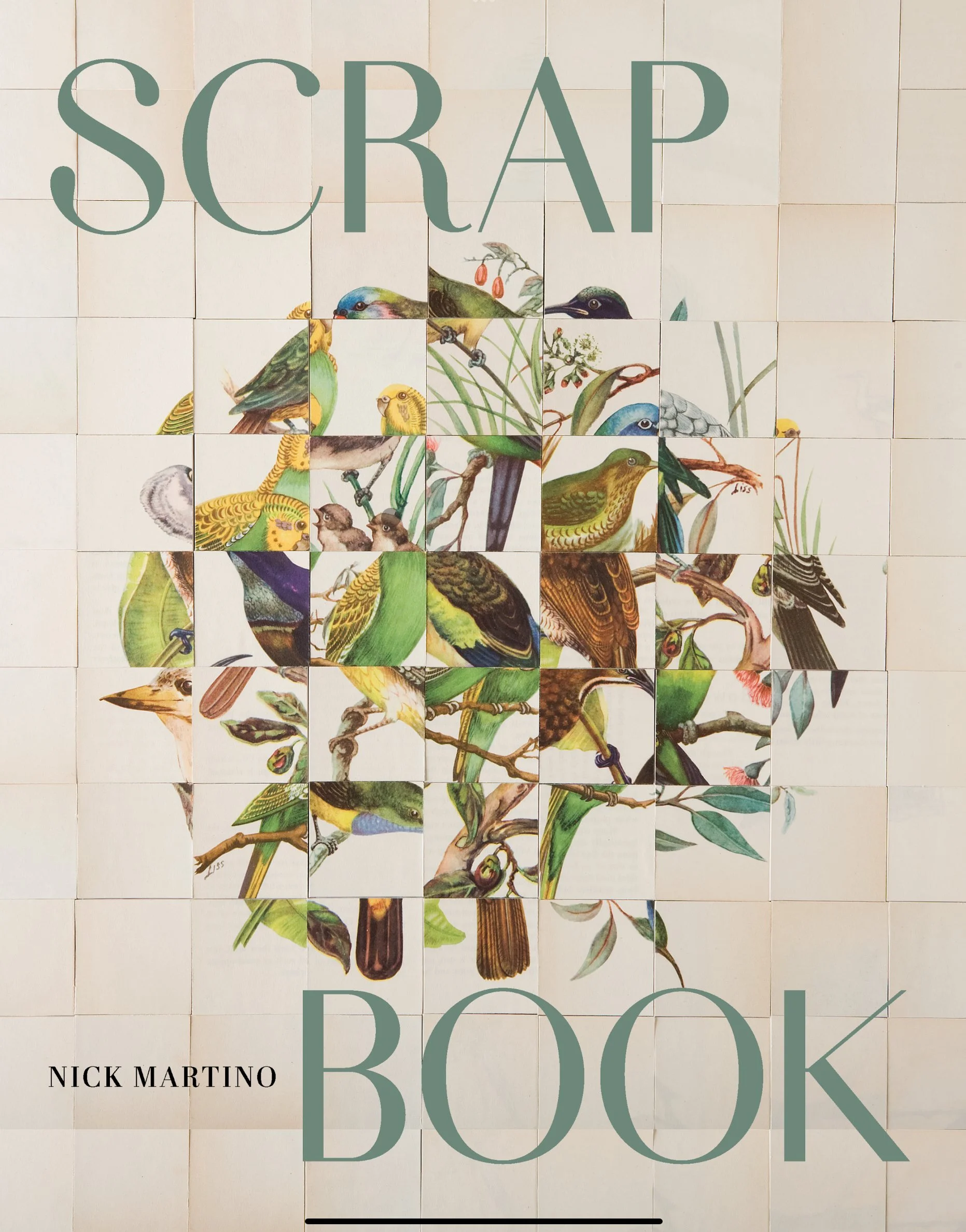
Scrap Book draws on Marianne Hirsch's theory of postmemory: "the relationship of the second generation to powerful, often traumatic, experiences that preceded their birth but that were nevertheless transmitted to them so deeply." Interwoven with poems grounded in a familial archive—such as journal entries and Polaroids of Martino's father in prison—the collection uses the idea of photographic development as a framework for exploring how insight into family history can emerge gradually, like an image appearing in a darkroom.
Through its use of ekphrasis and archival fragments, Scrap Book creates a textural interior landscape in which the speaker wrestles with how they see themselves and how they are seen by others. In reassembling the family archive, Martino opens a space for readers to do the same: to sift through memory, injury, and ego, and fashion from their own "scraps" a deeper understanding of what they carry.
Scrap Book is a work of gathering and repair: a lyrical stitching-together of fragments in search of meaning.
A look at the “Polaroid poems,” the genesis for Scrap Book.
Below is one Polaroid Poem from the book, which fills in over the course of 3 pages.
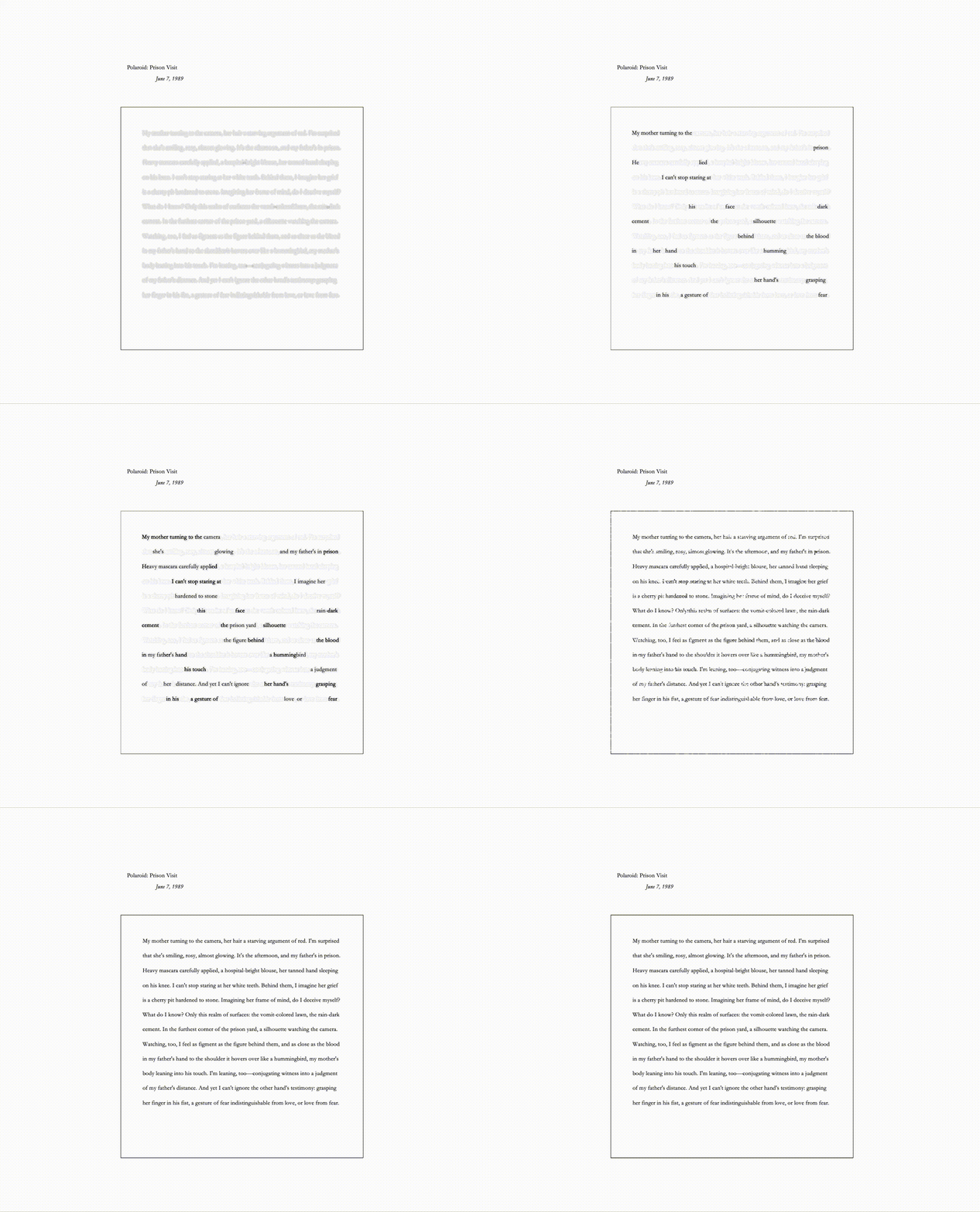
Here is a look at 3 Polaroid Poems from
Scrap Book. Click on any to enlarge.
What others have said about Scrap Book
-
“Scrap Book is a striking and ambitious debut. For Nick Martino, love is non-linear and layered. The first devotions rattle the present and the future; regret ripples through devotion. Hard-won observations about family and the self are as exhilarating as the imagery and phrasing. The language will stay with you. The language will surprise you. Cursive script tightens and explodes on the page. Recasting erasure poetry as ‘Polaroids’ is ingenious, impactful. Martino has written an inimitable first book.“
—Eduardo Corral
-
“Just over halfway into this searing and tender debut, Nick Martino writes, ‘I confess to regarding my father / as a villain in my mother’s history / of fire, incarceration, and silence.’ This confession is remarkable not because it lays succinctly bare the core of Scrap Book’s project, but because it is a found poem taken from one of the book’s ‘Polaroid’ poem series. Isolated from the fabric of a(n erased) longer poem as if manifested using a cookie cutter, the poem is fragment, is both the tight quarters of a prison cell and also the (w)hole of the collection. Scrap Book gathers memories—the speaker’s as a child, that of one’s parents; it pores over a mother’s handwriting, zooming into swirls of a letter until the word is unrecognizable, composing with the family archive in order to unearth and assert the presence of a future self—an unborn son birthed and grown up. This is a deeply intimate, immaculately crafted, lyrical auto-ethnographic documentation of the unspoken hungers within a family. I am forever altered by its intimate investigations.”
—Diana Khoi Nguyen
-
"In Nick Martino’s Scrap Book, love and fear blur together in the context of family trauma, addiction, estrangement, and the intimacies that can become their own rescuing landscape, filling in the distances between parent and child. Meanwhile, Martino’s inventiveness with form enacts the restlessness of memory, its shapeshifting qualities in the face of a human impulse to know what was true, whom to trust. I loved the surprise, the tenderness, and the fearless precision of these poems; Scrap Book is an exciting debut, indeed."
—Carl Phillips
About the book:
-
In October of last year I flew home to take care of my mother after she fell off a ladder and shattered her heel in thirteen places. While at home, I was given a cache of Polaroid photographs of my parents from 1989, four years before I was born. I knew the history, but it was the first time I’d glimpsed photographic evidence of the narrative that had both preceded and dominated my life—an aftermath whose pieces I have spent so long trying to glue back together.
To think through the archive, I wrote an ekphrasis of each Polaroid with a form that I invented for the purpose of this project: twelve lines of equal length so that their squareness might resemble a Polaroid’s picture window. Proximity and distance are the engines of these poems. They're “developments”: erasures sequenced in reverse, where the erasure begins the poem, and then the full text fills in, like a Polaroid developing over time, or like my understanding of lineage, inheritance, and my parents’ lives outside my own developing over time.
This project has expanded into a full-length manuscript tentatively titled Scrap Book. This project examines intergenerational trauma, silence, and incarceration. I’m looking forward to the book hopefully being out in the world one day; until then, many poems from the manuscript are available to read under “Publications”.
-
The book explores a journal that my mother kept at the time of my father’s incarceration: her account of select visitation days interspersed with observations of the color of Lake Michigan.
I’ve scanned her writing and included it in the book, writing alongside her as call and response or echo, building sculptures from her words, zooming into letters until they become an entirely new landscape to inhabit. Interwoven are poems describing Polaroid photos of my father in prison, featuring a poetic form I created for the book called the Polaroid: box-shaped prose poems that begin partially erased and then fill in, “developing” across several pages. In this way, the collection uses the idea of photographic development as a framework for exploring how insight into family history can emerge gradually, like an image appearing in a darkroom.
-
I want Scrap Book to reach the incarcerated, the formerly incarcerated, and their families. I want it to reach anyone who’s ever wondered about the afterlife of prison, and those who have never wondered about it. I want it to reach individuals with a family secret that feels so heavy they don’t know how or where to put it down.
Ultimately, Scrap Book is a work of gathering and repair—a lyrical stitching-together of fragments in search of meaning. In reassembling the family archive, I hope to open a space for readers to do the same: to sift through memory, injury, and identity, and fashion from their own “scraps” a deeper understanding of what they carry.